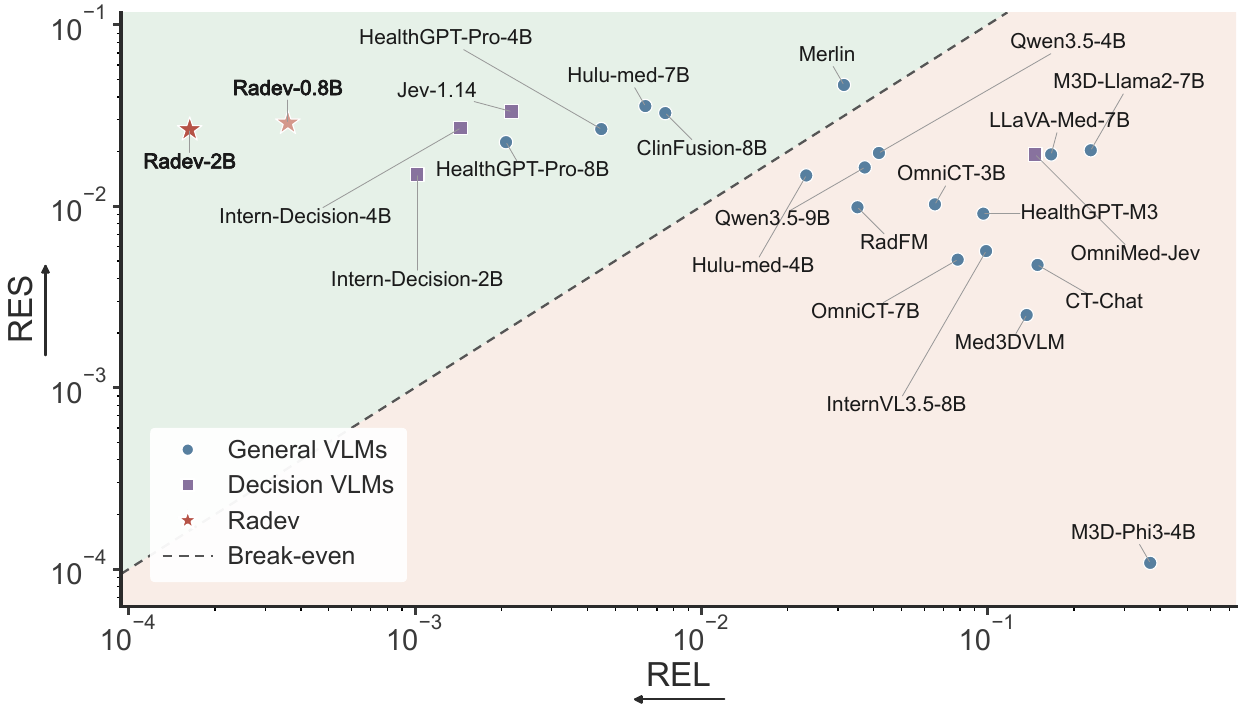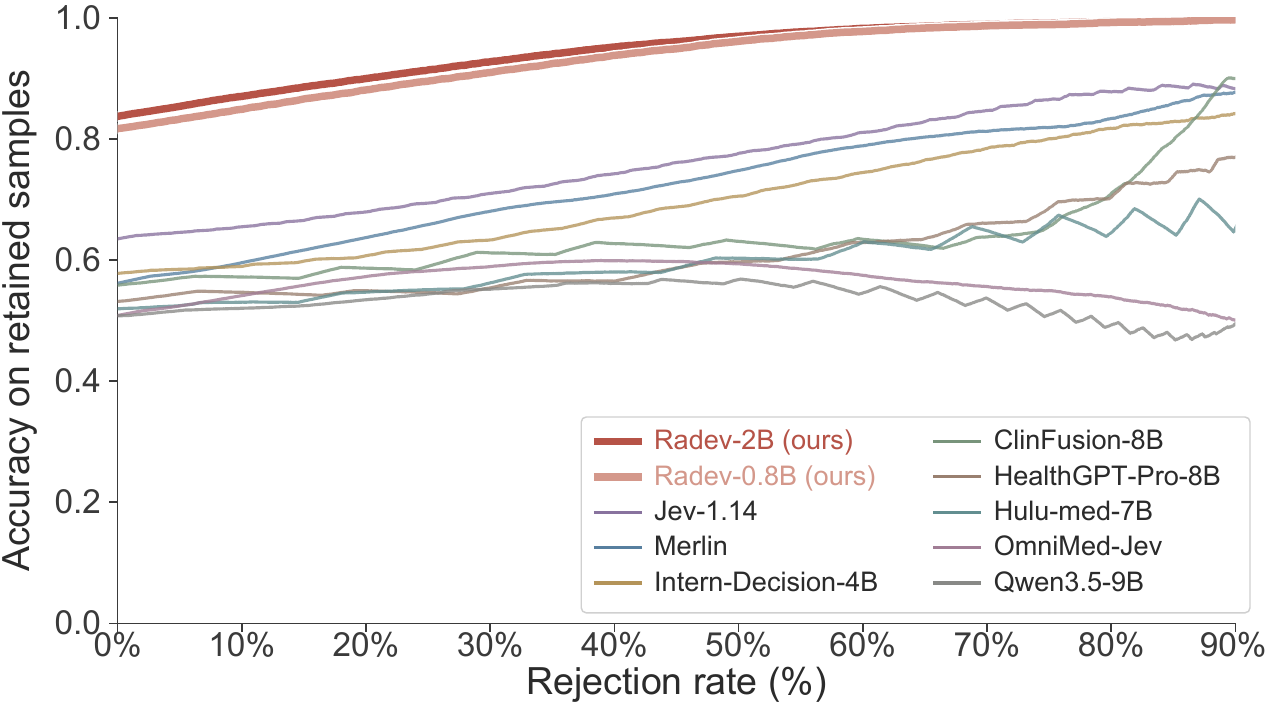

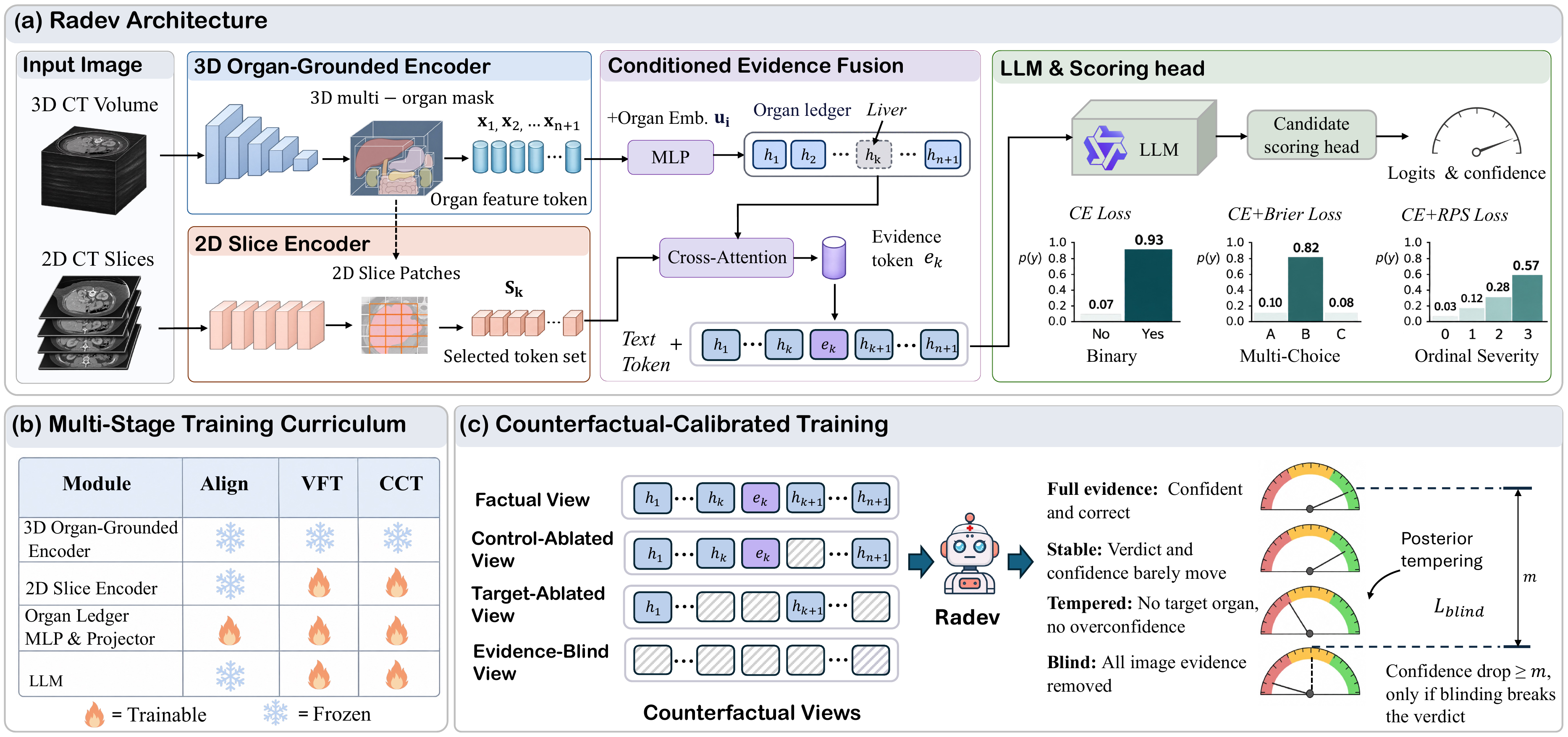
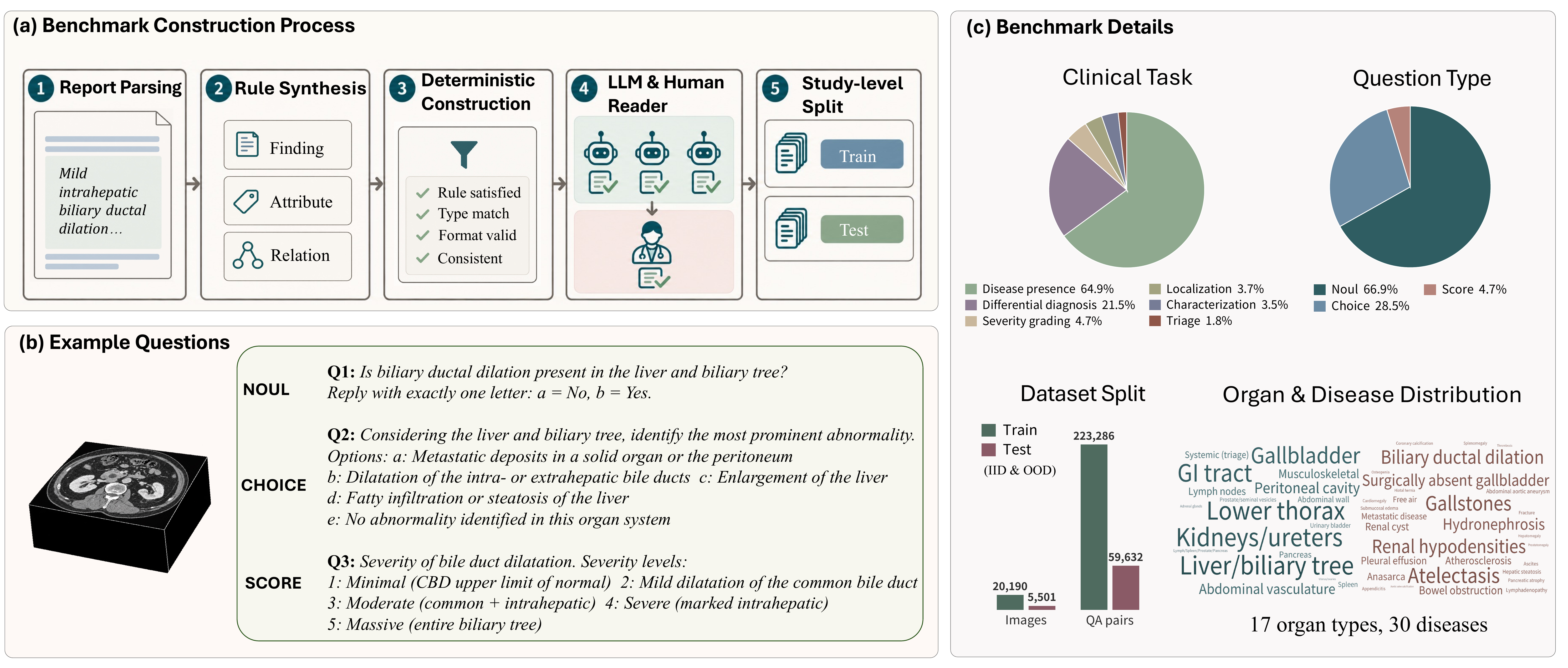
Paper Tables 1–2. Acc is per-question exact-match accuracy; mBAcc/mAUC are macro means over finding diseases; Score MAE/KRPS/QWK are over levels 0–4. (Metrics Guide: ↑ Higher is Better ↓ Lower is Better) Bold = best in column. OOD labels never enter fitting or model selection.
CT-Verdict-IID — binary findings (Noul)
| # | Model | Acc ↑ | mBAcc ↑ | mAUC ↑ | ECE ↓ | Brier ↓ |
|---|---|---|---|---|---|---|
| 1 | LLaVA-Med-7B | 39.94 | 50.61 | 61.31 | 0.35 | 0.71 |
| 2 | RadFM | 58.88 | 50.03 | 51.72 | 0.11 | 0.47 |
| 3 | CT-Chat | 41.92 | 50.09 | 52.07 | 0.34 | 0.71 |
| 4 | M3D-Phi3-4B | 47.48 | 54.55 | 57.85 | 0.50 | 1.01 |
| 5 | M3D-Llama2-7B | 52.31 | 50.45 | 52.27 | 0.18 | 0.61 |
| 6 | Merlin | 66.56 | 56.06 | 79.70 | 0.16 | 0.43 |
| 7 | HealthGPT-M3 | 43.14 | 49.79 | 55.40 | 0.32 | 0.71 |
| 8 | Med3DVLM | 63.13 | 50.44 | 54.94 | 0.28 | 0.65 |
| 9 | InternVL3.5-8B | 43.94 | 53.67 | 72.44 | 0.24 | 0.57 |
| 10 | Hulu-med-4B | 50.71 | 57.72 | 74.71 | 0.13 | 0.47 |
| 11 | Hulu-med-7B | 64.67 | 61.73 | 78.71 | 0.07 | 0.41 |
| 12 | Qwen3.5-4B | 53.16 | 58.44 | 75.02 | 0.15 | 0.51 |
| 13 | Qwen3.5-9B | 57.90 | 63.08 | 76.58 | 0.09 | 0.44 |
| 14 | OmniCT-3B | 44.79 | 52.28 | 56.73 | 0.16 | 0.54 |
| 15 | OmniCT-7B | 40.27 | 50.00 | 39.73 | 0.25 | 0.61 |
| 16 | HealthGPT-Pro-4B | 70.96 | 65.90 | 76.68 | 0.10 | 0.41 |
| 17 | HealthGPT-Pro-8B | 62.03 | 68.04 | 77.31 | 0.02 | 0.45 |
| 18 | ClinFusion-8B | 65.66 | 56.58 | 64.68 | 0.08 | 0.44 |
| 19 | GPT-5.4 | 70.23 | 69.24 | - | - | - |
| 20 | OmniMed-Jev | 59.68 | 50.55 | 50.66 | 0.39 | 0.78 |
| 21 | Intern-Decision-2B | 57.32 | 60.66 | 71.09 | 0.02 | 0.48 |
| 22 | Intern-Decision-4B | 64.95 | 60.20 | 70.92 | 0.04 | 0.43 |
| 23 | Jev-1.14 | 71.39 | 65.14 | 79.31 | 0.04 | 0.37 |
| 24 | Radev-0.8B (ours) | 88.20 | 66.59 | 85.48 | 0.01 | 0.17 |
| 25 | Radev-2B (ours) | 90.08 | 71.79 | 87.79 | 0.01 | 0.15 |
CT-Verdict-IID — multiple choice (Choice)
| Model | Acc ↑ | mBAcc ↑ | mAUC ↑ | ECE ↓ | Brier ↓ |
|---|---|---|---|---|---|
| LLaVA-Med-7B | 19.69 | 49.82 | 50.15 | 0.42 | 1.05 |
| RadFM | 39.36 | 49.92 | 50.42 | 0.25 | 0.89 |
| CT-Chat | 22.30 | 50.21 | 52.22 | 0.41 | 1.11 |
| M3D-Phi3-4B | 9.71 | 50.01 | 50.95 | 0.85 | 1.72 |
| M3D-Llama2-7B | 8.72 | 50.01 | 50.39 | 0.81 | 1.67 |
| Merlin | 38.22 | 50.56 | 61.49 | 0.14 | 0.77 |
| HealthGPT-M3 | 23.12 | 50.19 | 52.93 | 0.25 | 0.89 |
| Med3DVLM | 28.74 | 50.89 | 52.75 | 0.52 | 1.21 |
| InternVL3.5-8B | 20.23 | 49.34 | 49.62 | 0.48 | 1.16 |
| Hulu-med-4B | 30.31 | 52.86 | 64.08 | 0.27 | 0.94 |
| Hulu-med-7B | 29.00 | 56.00 | 67.44 | 0.17 | 0.83 |
| Qwen3.5-4B | 29.69 | 52.54 | 64.87 | 0.29 | 0.92 |
| Qwen3.5-9B | 36.64 | 54.52 | 67.60 | 0.24 | 0.79 |
| OmniCT-3B | 23.79 | 50.25 | 55.46 | 0.37 | 1.00 |
| OmniCT-7B | 19.44 | 50.57 | 54.89 | 0.33 | 0.97 |
| HealthGPT-Pro-4B | 37.50 | 55.73 | 69.57 | 0.07 | 0.74 |
| HealthGPT-Pro-8B | 35.93 | 55.89 | 67.80 | 0.08 | 0.76 |
| ClinFusion-8B | 37.65 | 51.26 | 56.51 | 0.11 | 0.72 |
| GPT-5.4 | 45.92 | 64.31 | - | - | - |
| OmniMed-Jev | 36.06 | 51.39 | 57.91 | 0.37 | 0.93 |
| Intern-Decision-2B | 38.05 | 58.92 | 68.82 | 0.03 | 0.72 |
| Intern-Decision-4B | 45.49 | 57.37 | 65.17 | 0.02 | 0.68 |
| Jev-1.14 | 50.99 | 58.52 | 71.78 | 0.02 | 0.63 |
| Radev-0.8B (ours) | 68.61 | 57.73 | 78.19 | 0.02 | 0.44 |
| Radev-2B (ours) | 71.33 | 62.06 | 81.91 | 0.02 | 0.41 |
CT-Verdict-IID — ordinal severity (Score)
| Model | MAE ↓ | KRPS ↓ | QWK ↑ | ECE ↓ | Brier ↓ |
|---|---|---|---|---|---|
| LLaVA-Med-7B | 0.75 | 0.14 | 0.15 | 0.19 | 0.93 |
| RadFM | 0.93 | 0.21 | 0.07 | 0.54 | 1.19 |
| CT-Chat | 0.96 | 0.18 | -0.08 | 0.46 | 1.03 |
| M3D-Phi3-4B | 0.99 | 0.21 | 0.11 | 0.51 | 1.13 |
| M3D-Llama2-7B | 1.00 | 0.22 | -0.01 | 0.60 | 1.32 |
| Merlin | 0.70 | 0.14 | 0.13 | 0.24 | 0.89 |
| HealthGPT-M3 | 1.04 | 0.18 | 0.06 | 0.12 | 0.83 |
| Med3DVLM | 0.80 | 0.17 | 0.29 | 0.44 | 1.04 |
| InternVL3.5-8B | 1.05 | 0.17 | -0.02 | 0.09 | 0.78 |
| Hulu-med-4B | 1.06 | 0.17 | 0.24 | 0.11 | 0.80 |
| Hulu-med-7B | 1.39 | 0.24 | 0.22 | 0.25 | 0.95 |
| Qwen3.5-4B | 1.12 | 0.19 | 0.23 | 0.14 | 0.85 |
| Qwen3.5-9B | 1.27 | 0.22 | 0.19 | 0.16 | 0.88 |
| OmniCT-3B | 1.17 | 0.21 | 0.07 | 0.30 | 0.93 |
| OmniCT-7B | 0.88 | 0.15 | 0.02 | 0.19 | 0.81 |
| HealthGPT-Pro-4B | 1.05 | 0.17 | 0.30 | 0.13 | 0.80 |
| HealthGPT-Pro-8B | 0.93 | 0.15 | 0.34 | 0.09 | 0.77 |
| ClinFusion-8B | 1.02 | 0.17 | 0.22 | 0.09 | 0.81 |
| GPT-5.4 | 0.75 | - | 0.46 | - | - |
| OmniMed-Jev | 0.79 | 0.17 | 0.11 | 0.31 | 0.93 |
| Intern-Decision-2B | 0.57 | 0.10 | 0.40 | 0.07 | 0.68 |
| Intern-Decision-4B | 0.52 | 0.10 | 0.35 | 0.13 | 0.73 |
| Jev-1.14 | 0.60 | 0.12 | 0.36 | 0.21 | 0.79 |
| Radev-0.8B (ours) | 0.40 | 0.06 | 0.53 | 0.03 | 0.42 |
| Radev-2B (ours) | 0.39 | 0.06 | 0.54 | 0.02 | 0.41 |
CT-Verdict-OOD (external volumes, prediction-only)
| Model | Noul Acc ↑ | Noul mAUC ↑ | Choice Acc ↑ | Choice mAUC ↑ | Score MAE ↓ | Score KRPS ↓ |
|---|---|---|---|---|---|---|
| LLaVA-Med-7B | 35.80 | 55.80 | 17.60 | 58.50 | 0.653 | 0.152 |
| RadFM | 55.70 | 43.50 | 55.40 | 46.00 | 0.582 | 0.130 |
| CT-Chat | 40.00 | 39.70 | 8.90 | 51.30 | 1.440 | 0.229 |
| M3D-Llama2-7B | 41.80 | 53.10 | 15.70 | 51.40 | 0.993 | 0.222 |
| Merlin | 61.30 | 69.90 | 11.20 | 62.70 | 0.501 | 0.141 |
| HealthGPT-M3 | 42.30 | 47.90 | 22.60 | 50.60 | 1.125 | 0.185 |
| Med3DVLM | 56.40 | 60.30 | 9.10 | 53.90 | 0.910 | 0.197 |
| InternVL3.5-8B | 42.00 | 64.70 | 18.10 | 56.70 | 0.945 | 0.159 |
| Hulu-med-7B | 64.90 | 66.20 | 19.60 | 71.40 | 1.417 | 0.237 |
| Qwen3.5-9B | 54.31 | 65.60 | 25.34 | 61.76 | 1.191 | 0.185 |
| OmniCT-7B | 41.80 | 45.40 | 14.00 | 57.00 | 0.943 | 0.147 |
| HealthGPT-Pro-8B | 56.70 | 71.60 | 35.00 | 70.20 | 0.990 | 0.162 |
| ClinFusion-8B | 55.73 | 47.40 | 58.18 | 57.17 | 1.143 | 0.177 |
| GPT-5.4 | 63.93 | - | 36.70 | - | 0.763 | - |
| OmniMed-Jev | 59.90 | 43.80 | 54.20 | 61.80 | 0.558 | 0.123 |
| Intern-Decision-4B | 63.30 | 64.60 | 53.70 | 58.60 | 0.321 | 0.106 |
| Jev-1.14 | 62.90 | 71.70 | 53.30 | 67.90 | 0.504 | 0.122 |
| Radev-0.8B (ours) | 69.96 | 72.89 | 65.79 | 72.31 | 0.279 | 0.032 |
| Radev-2B (ours) | 72.72 | 77.61 | 69.29 | 75.16 | 0.234 | 0.028 |